

The Ultimate Step-by-Step Guide to Changing Order of Integration with Examples
If you’ve ever looked at a double or triple integral and thought, this looks impossible to solve, there’s a good chance you’re facing an integral where you need to change the order of integration. In this step-by-step guide to changing order of integration, you’ll learn exactly how and when to change the order of integration. Whether you’re working through double integrals over general regions or evaluating a triple integral bounded by surfaces, changing the order can often turn a difficult integral into one that is simpler.
In this article, we’ll walk through the entire process, from sketching the region to identifying the new limits and rewriting the integral correctly. Along the way, you’ll see examples that demonstrate how this technique works in both two and three dimensions.
If you need a refresher on double and triple integrals, be sure to check out the articles A Step-by-Step Beginner’s Tutorial for Double and Triple Integrals in Calculus and Double and Triple Integrals Explained with Examples for General Regions: A Complete Beginner’s Guide. These will give you the background you need to learn the material in this guide.
This article is part of a five-part series on evaluating multiple integrals. The following infographic illustrates this topic.
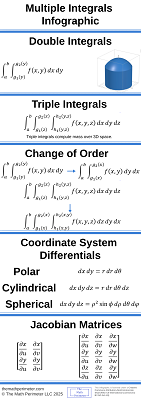
Changing the Order of Integration
What Does It Mean to Change the Order of Integration?
When evaluating a double or triple integral, the order of integration refers to the sequence in which you integrate with respect to each variable. For example, in a double integral, written as
$$\int_a^b \int_{g_1(x)}^{g_2(x)} f(x, y) \, dy \, dx,$$
you integrate with respect to \( y \) first, then \( x \). Changing the order of integration means rewriting the integral so that you integrate with respect to \( x \) first, then \( y \), or, in a triple integral, reordering any of the three variables.
Why Change the Order?
Changing the order of integration is not just a theoretical exercise. It’s a powerful strategy for solving integrals that would otherwise be difficult or impossible to evaluate in their original form. Situations, where we should consider changing the order, include when the original limits are difficult to work with or when the computation becomes simpler after switching the order.
How Changing Order Works in Practice
Here’s a quick example of what changing the order looks like:
$$\int_0^1 \int_x^1 f(x, y) \, dy \, dx$$
$$\int_0^1 \int_0^y f(x, y) \, dx \, dy$$
Both of these represent the same region and compute the same value, but depending on the function \( f(x, y) \), one order may be significantly easier to evaluate than the other.
In three dimensions, the concept is the same, but now you’re dealing with a volume instead of an area. Changing the order means choosing a new sequence, such as integrating \( z \) first, then \( x \), and then \( y \), and adjusting the limits accordingly.
The Step-by-Step Process for Changing the Order of Integration
The process for changing the order of integration can be broken into steps. Whether you’re working with double or triple integrals, the strategy is basically the same.
Step 1: Sketch the Region of Integration
This is the single most important step. You cannot reliably change the order of integration without understanding the region over which you’re integrating.
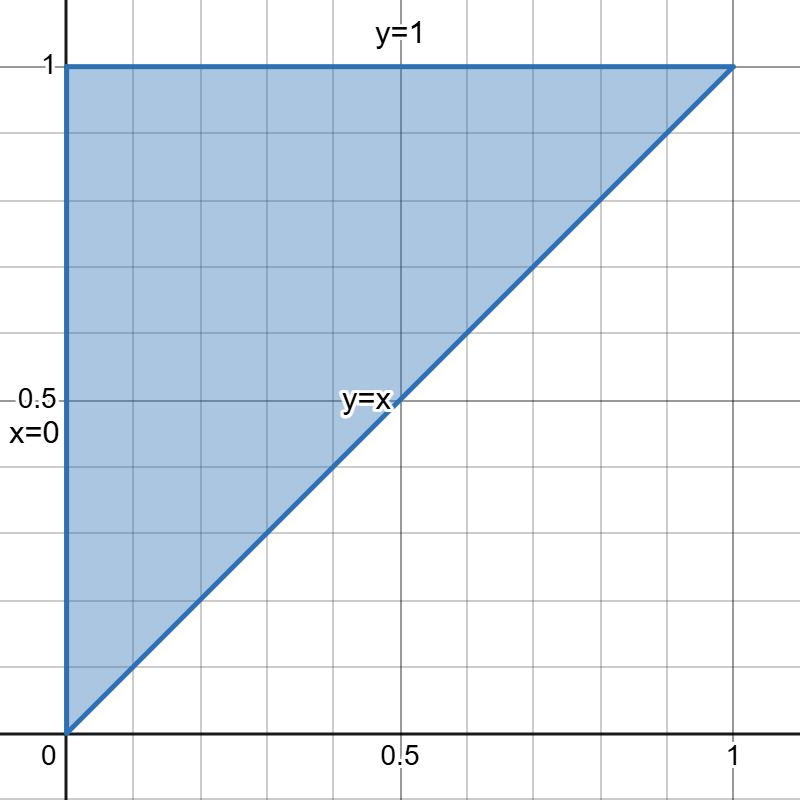
For example, consider the region described by
$$ \{ (x,y) | 0 \leq x \leq 1, x \leq y \leq 1 \}. $$
Below is an illustration of this region.
Step 2: Describe the Region in Terms of the Desired Order
For example, the region above can be described as
$$ \{ (x,y) | 0 \leq x \leq y, 0 \leq y \leq 1 \}. $$
Step 3: Rewrite the Integral and Evaluate.
Now that you have the new limits change the differential so that it has the desired order. Keep the integrand the same, change the limits accordingly, and evaluate the new integral.
Worked Out Examples
In this section, we’ll walk through four examples that show how to change the order of integration. Each example demonstrates a different scenario you may encounter, ranging from optional order changes that simplify the solution process to mandatory changes that are essential for solving the problem.
These examples will make use of various integration techniques, including algebraic manipulation, substitution, and integration by parts. For a review of these topics, please refer to the respective articles Basic Integration Problems for Beginners, The Ultimate Step-by-Step Guide to Solving Integrals Using Substitution, and Integration by Parts Explained with Examples: A Step-by-Step Guide.
Example 1: Evaluate the following integrals by changing the order of integration:
(a) \( \int_0^1 \int_0^2 3x + 2y dxdy \)
(b) \( \int_0^1 \int_{\sqrt{y}}^1 \frac{x}{\sqrt{1 – x^4}} dxdy \)
(c) \( \int_0^1 \int_0^2 \int_0^3 x + y + z dzdydx \)
(d) \( \int_0^1 \int_0^x \int_0^y z e^{x} dzdydx \)
Solution: (a) \( \int_0^1 \int_0^2 3x + 2y dxdy \)
Since we are integrating over a rectangle, we do not need to sketch the region. Changing the order we arrive at
$$\int_0^2 \int_0^1 3x + 2y dydx.$$
The inner integral is with respect to y, so we treat \( x \) as a constant and integrate with respect to \( y \) to get
$$\int_0^2 3xy + y^2|_0^1 dx.$$
Applying the Fundamental Theorem of Calculus gives
$$\int_0^2 3x + 1 dx.$$
Now, we integrate with respect to x to obtain
$$\frac{3}{2}x^2 + x|_0^2.$$
Applying the Fundamental Theorem of Calculus again, we arrive at a final answer of
$$8.$$
(b) \( \int_0^1 \int_{\sqrt{y}}^1 \frac{x}{\sqrt{1 – x^4}} dxdy \)
The following picture is a sketch of the region.
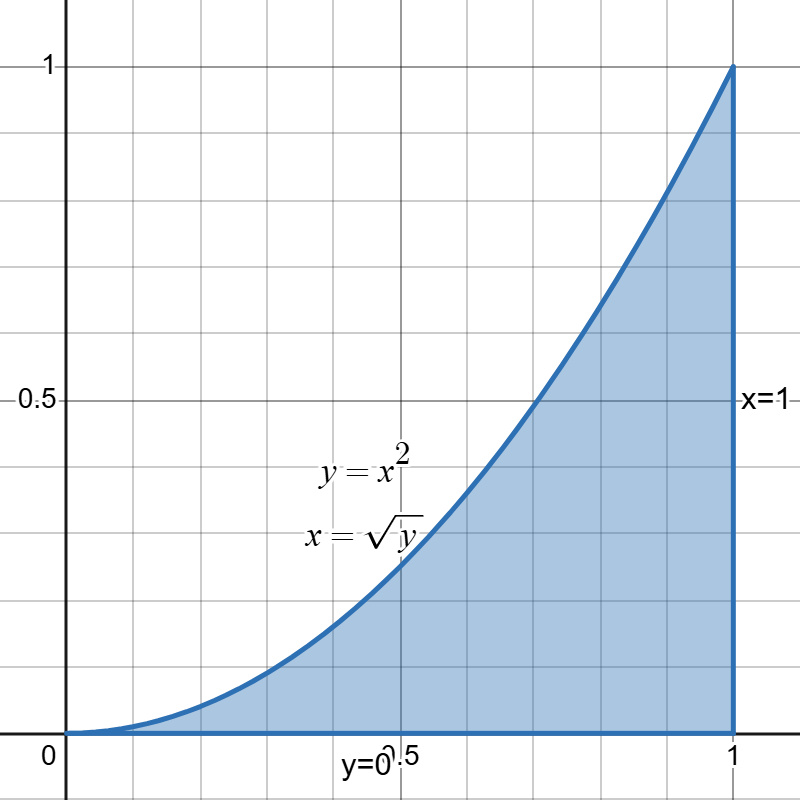
We can describe this region as
$$\{ (x,y) | 0 \leq x \leq 1, 0 \leq y \leq x^2 \}.$$
Hence, our new integral is
$$\int_0^1 \int_0^{x^2} \frac{x}{\sqrt{1 – x^4}} dydx.$$
The inner integral is with respect to y, so we treat \( x \) as a constant and integrate with respect to \( y \) to get
$$\int_0^1 \frac{xy}{\sqrt{1 – x^4}}|_0^{x^2} dx.$$
Applying the Fundamental Theorem of Calculus gives
$$\int_0^1 \frac{x^3}{\sqrt{1 – x^4}} dx.$$
To evaluate the remaining integral, we use a substitution. Let \( u = 1 – x^4 \), then \( du = -4x^3dx \), which implies \( -\frac{1}{4}du = x^3dx \). The new limits are \( 1 – 0^4 = 1 \) and \( 1 – 1^4 = 0 \). Substituting into the integral gives
$$-\frac{1}{4}\int_1^0 \frac{1}{\sqrt{u}} du.$$
In terms of fractional exponents, this is
$$-\frac{1}{4}\int_1^0 \frac{1}{u^{\frac{1}{2}}} du.$$
This is equivalent to
$$-\frac{1}{4}\int_1^0 u^{-\frac{1}{2}} du.$$
Now, we integrate with respect to u to obtain
$$-\frac{1}{2} u^{\frac{1}{2}}|_1^0.$$
Applying the Fundamental Theorem of Calculus again, we arrive at a final answer of
$$\frac{1}{2}.$$
(c) \( \int_0^1 \int_0^2 \int_0^3 x + y + z dzdydx \)
Since we are integrating over a box, we do not need to sketch the region. Changing the order we arrive at
$$\int_0^3 \int_0^2 \int_0^1 x + y + z dxdydz.$$
The inner integral is with respect to x, so we treat \( y \) and \( z \) as constants and integrate with respect to \( x \) to get
$$\int_0^3 \int_0^2 \frac{1}{2}x^2 + xy + xz|_0^1 dydz.$$
Applying the Fundamental Theorem of Calculus gives
$$\int_0^3 \int_0^2 \frac{1}{2} + y + z dydz.$$
We now integrate with respect to y while treating z as a constant. This gives
$$\int_0^3 \frac{1}{2}y + \frac{1}{2}y^2 + yz|_0^2 dz.$$
Applying the Fundamental Theorem of Calculus again, we arrive at
$$\int_0^3 3 + 2z dz.$$
Now, we integrate with respect to z to obtain
$$3z + z^2|_0^3.$$
Applying the Fundamental Theorem of Calculus once again, we arrive at a final answer of
$$18.$$
(d) \( \int_0^1 \int_0^x \int_0^y z e^{x} dzdydx \)
The following picture is a sketch of the region.
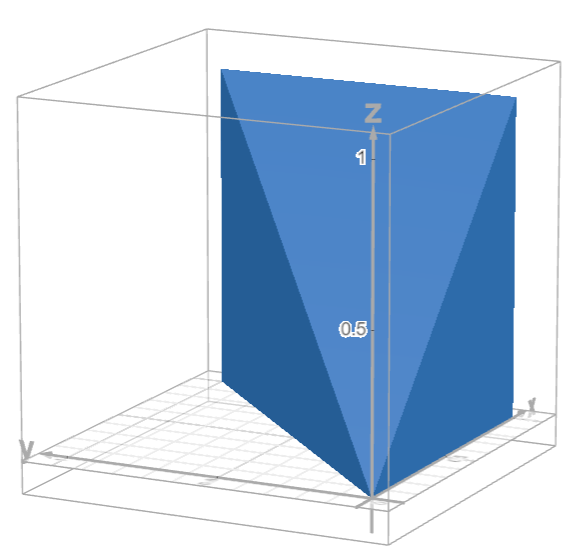
We can describe this region as
$$\{ (x,y,z) | y \leq x \leq 1, z \leq y \leq 1, 0 \leq z \leq 1 \}.$$
Hence, our new integral is
$$\int_0^1 \int_z^1 \int_y^1 z e^x dxdydz.$$
The inner integral is with respect to x, so we treat \( y \) and \( z \) as constants and integrate with respect to \( x \) to get
$$\int_0^1 \int_z^1 z e^x|_y^1 dydz.$$
Applying the Fundamental Theorem of Calculus gives
$$\int_0^1 \int_z^1 ez – ze^y dydz.$$
We now integrate with respect to y while treating z as a constant. This gives
$$\int_0^1 eyz – ze^y|_z^1 dz.$$
Applying the Fundamental Theorem of Calculus again, we arrive at
$$\int_0^1 ze^z – ez^2 dz.$$
To evaluate this integral, we use linearity, which gives
$$\int_0^1 ze^z dz – \int_0^1 ez^2 dz.$$
The first integral can be evaluated using integration by parts. Choose \( u = z \) and \( dv = e^zdz \), then \( du = dz \) and \( v = e^z \). Applying the integration by parts formula to the first integral then gives
$$ze^z|_0^1 – \int_0^1 e^z dz – \int_0^1 ez^2 dz.$$
Now, we integrate with respect to z to obtain
$$e – e^z|_0^1 – \frac{e}{3}z^3|_0^1.$$
Applying the Fundamental Theorem of Calculus once again, we arrive at a final answer of
$$1 – \frac{e}{3}.$$
Conclusion
Changing the order of integration is a powerful and often necessary technique in multivariable calculus. As you’ve seen throughout this step-by-step guide to changing order of integration, understanding the geometry of the region of integration and carefully redrawing the bounds can simplify your computations, and sometimes, this can mean the difference between a solvable and an unsolvable integral.
Further Reading
A Complete Beginner’s Guide to Polar, Cylindrical, and Spherical Coordinates in Calculus – Multivariable calculus is often done in different coordinate systems. This guide covers the most commonly used coordinate systems.
How to Find the Determinant of a Matrix Step by Step: A Complete Beginner’s Guide – Calculating determinants is necessary to change variables of integration, another important technique for evaluating multiple integrals.

