

Step-by-Step Tutorial on How to Use Polar, Cylindrical, and Spherical Coordinates in Integrals
In multivariable calculus, one of the most effective strategies for solving double and triple integrals is switching from rectangular (Cartesian) coordinates to a more suitable coordinate system. If you’ve ever encountered a complicated region or integrand and wondered how to make the integral easier to compute, the answer often lies in learning how to use polar, cylindrical, and spherical coordinates in integrals. These alternative coordinate systems can simplify integration over circular, cylindrical, or spherical regions.
This tutorial is designed to guide you through the process of converting coordinates in double and triple integrals from rectangular to polar, cylindrical, and spherical coordinates. You’ll learn when to use each system, how to convert coordinates, and how to compute integrals in these new coordinates.
If you’re new to these coordinate systems or need a refresher on the basics of polar, cylindrical, and spherical coordinates themselves, check out our companion article, A Complete Beginner’s Guide to Polar, Cylindrical, and Spherical Coordinates in Calculus.
This article is part of a five-part series on evaluating multiple integrals. The following infographic illustrates this topic.
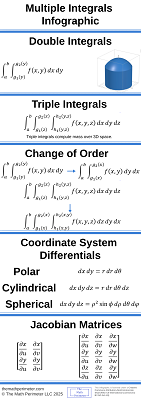
When and Why to Change Coordinates in Integrals
Changing coordinates is such a powerful technique in multivariable calculus because a well-chosen coordinate system can transform a messy double or triple integral into one that is much more manageable. Common reasons to change coordinates include exploiting symmetry, simplifying complicated boundaries, and simplifying integrands.
Steps for Changing Coordinates in an Integral
Changing coordinates in a double or triple integral always follows a predictable and logical process. Whether you’re switching to polar, cylindrical, or spherical coordinates, the underlying steps are the same.
Step 1: Identify the Proper Coordinate System
- Use polar coordinates when the region is bounded by polar curves (such as circles, spirals, or sectors) or the integrand has expressions of the form \( x^2 + y^2 \).
- Use cylindrical coordinates when the region is a solid with circular cross-sections (like cylinders or tubes) or the integrand has expressions of the form \( x^2 + y^2 \).
- Use spherical coordinates when the region is spherical (like a ball, hemisphere, or spherical shell) or the integrand has expressions of the form \( x^2 + y^2 + z^2 \).
Step 2: Express \( x \), \( y \), and \( z \) in terms of the New Coordinates
Write the Cartesian variables in terms of the new coordinate system using the conversion formulas:
- Polar: \( x = r\cos\theta \), \( y = r\sin\theta \)
- Cylindrical: \( x = r\cos\theta \), \( y = r\sin\theta \), \( z = z \)
- Spherical: \( x = \rho\sin\phi\cos\theta \), \( y = \rho\sin\phi\sin\theta \), \( z = \rho\cos\phi \)
Step 3: Determine the Proper Differential
The differential introduces a scaling factor, and it’s different for each system. The new differentials are
- Polar: \( dx\,dy = r\,dr\,d\theta \)
- Cylindrical: \( dx\,dy\,dz = r\,dr\,d\theta\,dz \)
- Spherical: \( dx\,dy\,dz = \rho^2\sin\phi\,d\rho\,d\phi\,d\theta \)
Step 4: Transform the Limits of Integration
Translate the bounds of the region from Cartesian to the new coordinates.
This step is often the trickiest; I recommend sketching the region, as in The Ultimate Step-by-Step Guide to Changing Order of Integration with Examples, to help visualize it in the new coordinate system.
Step 5: Set Up the New Integral
Substitute everything into the integral, including the integrand in the new coordinate system, the differential, and the new limits of integration.
Step 6: Evaluate the Integral
Now that the integral is in terms of the new coordinates, compute it using the techniques covered in the articles A Step-by-Step Beginner’s Tutorial for Double and Triple Integrals in Calculus and Double and Triple Integrals Explained with Examples for General Regions: A Complete Beginner’s Guide.
Using Polar Coordinates in Double Integrals
Polar coordinates are ideal for regions involving circles, sectors, or radial symmetry. Note that many of our examples will make use of the methods covered in the article Basic Integration Problems for Beginners.
Example 1: Evaluate \( \iint_{x^2 + y^2 \leq 4} x^2 + y^2 dx\,dy \).
Solution: The following picture is a sketch of the region.
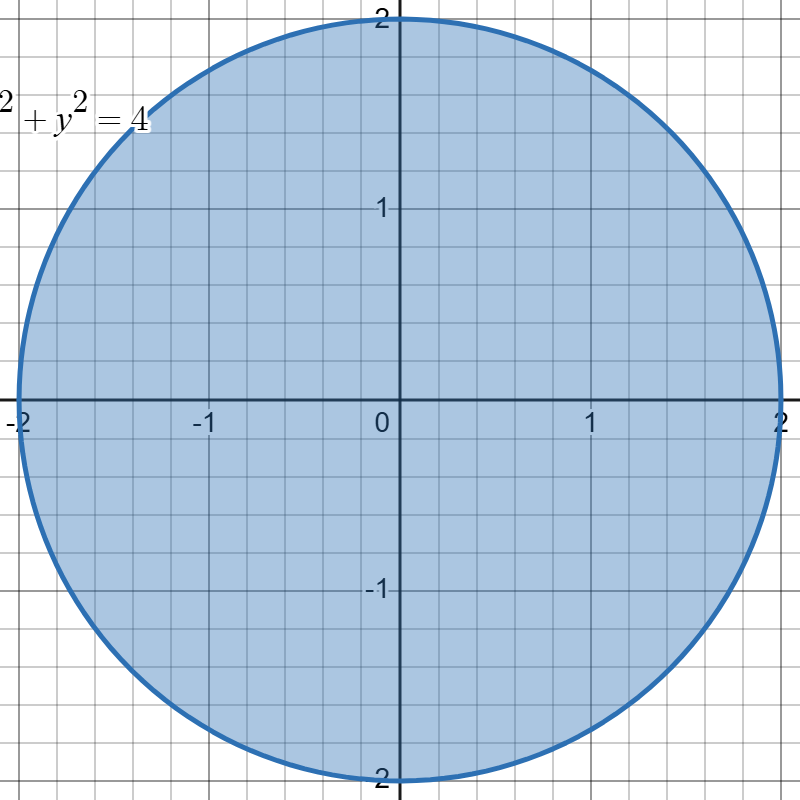
We can describe this region in polar coordinates as
$$ \{ (r, \theta) | 0 \leq r \leq 2, 0 \leq \theta \leq 2\pi \}.$$
Plugging in the substitutions \( x^2 + y^2 = r^2 \) and \( dx\,dy = r\,dr\,d\theta \), our new integral is
$$\int_0^{2\pi}\int_0^2 r^3 drd\theta.$$
The inner integral is with respect to r, so we treat \( \theta \) as a constant and integrate with respect to \( r \) to get
$$\int_0^{2\pi} \frac{1}{4}r^4|_0^2 d\theta.$$
Applying the Fundamental Theorem of Calculus gives
$$\int_0^{2\pi} 4 d\theta.$$
Now, we integrate with respect to \( \theta \) to obtain
$$4\theta|_0^{2\pi}.$$
Applying the Fundamental Theorem of Calculus again, we arrive at a final answer of
$$8\pi.$$
The following integral requires a substitution. Please check out The Ultimate Step-by-Step Guide to Solving Integrals Using Substitution to learn more about this method.
Example 2: Evaluate $$\iint_{R} \sin(x^2 + y^2) \, dx\,dy, \quad R: x^2 + y^2 \leq 1.$$
Solution: The following picture is a sketch of the region.
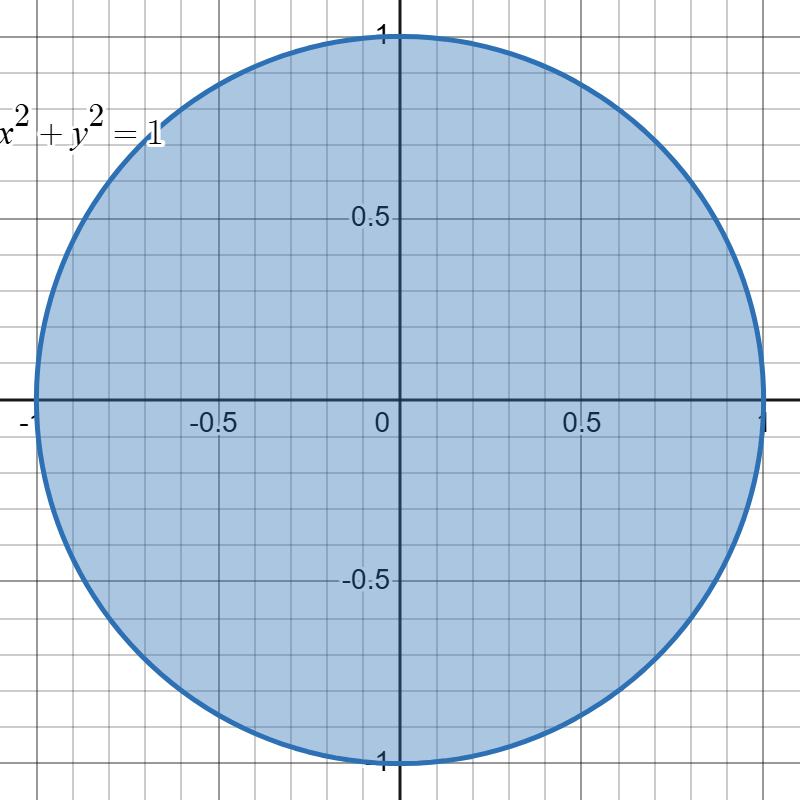
We can describe this region in polar coordinates as
$$ \{ (r, \theta) | 0 \leq r \leq 1, 0 \leq \theta \leq 2\pi \}.$$
Plugging in the substitutions \( x^2 + y^2 = r^2 \) and \( dx\,dy = r\,dr\,d\theta \), our new integral is
$$\int_0^{2\pi}\int_0^1 r\sin{r^2} drd\theta.$$
The Inner Integral is with respect to r, so we treat \( \theta \) as a constant and integrate with respect to \( r \). We begin with a substitution. Let \( u = r^2 \), then \( du = 2r dr \), which implies \( \frac{1}{2} du = r dr \). The new limits are \( 0^2 = 0 \) and \( 1^2 = 1 \). Substituting into the integral gives
$$\frac{1}{2}\int_0^{2\pi}\int_0^1 \sin{u} dud\theta.$$
Integrating with respect to u, we get
$$-\frac{1}{2}\int_0^{2\pi} \cos{u}|_0^1 d\theta.$$
Applying the Fundamental Theorem of Calculus gives
$$-\frac{1}{2}\int_0^{2\pi} \cos{1} – 1 d\theta.$$
Now, we integrate with respect to \( \theta \) to obtain
$$-\frac{1}{2}\theta (\cos{1} – 1)|_0^{2\pi}.$$
Applying the Fundamental Theorem of Calculus again, we arrive at a final answer of
$$-\pi(\cos{1} – 1).$$
Using Cylindrical Coordinates in Triple Integrals
Cylindrical coordinates extend polar coordinates to three dimensions by adding a height component, \( z \).
Example 3: Evaluate $$\iiint_E z\,dV, \quad E: x^2 + y^2 \leq 1,\; 0 \leq z \leq 2.$$
Solution: The following picture is a sketch of the region.
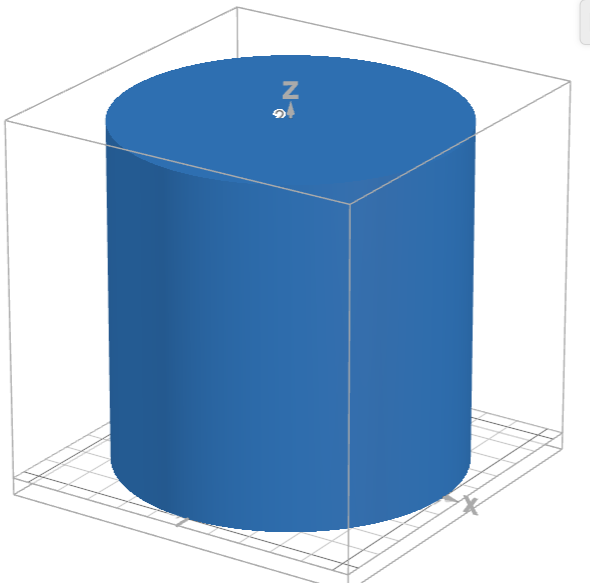
We can describe this region in cylindrical coordinates as
$$ \{ (r, \theta, z) | 0 \leq r \leq 1, 0 \leq \theta \leq 2\pi, 0 \leq z \leq 2 \}.$$
Plugging in the substitution \( dxdydz = rdrd\theta dz \), our new integral is
$$\int_0^2\int_0^{2\pi}\int_0^1 rz dr d\theta dz.$$
The inner integral is with respect to r, so we treat \( \theta \) and \( z \) as constants and integrate with respect to \( r \) to get
$$\frac{1}{2}\int_0^2\int_0^{2\pi} r^2z|_0^1 d\theta dz.$$
Applying the Fundamental Theorem of Calculus gives
$$\frac{1}{2}\int_0^2\int_0^{2\pi} z d\theta dz.$$
We now integrate with respect to \( \theta \) while treating z as a constant. This gives
$$\frac{1}{2}\int_0^2 \theta z|_0^{2\pi} dz.$$
Applying the Fundamental Theorem of Calculus again, we arrive at
$$\pi\int_0^2 z dz.$$
Now, we integrate with respect to z to obtain
$$\frac{\pi}{2}z^2|_0^2.$$
Applying the Fundamental Theorem of Calculus once again, we arrive at a final answer of
$$2\pi.$$
Our following example uses integration by parts. This technique is covered in depth in the article Integration by Parts Explained with Examples: A Step-by-Step Guide.
Example 4: Evaluate $$\iiint_E z\ln(z)\,dV, \quad E: x^2 + y^2 \leq 4,\; 1 \leq z \leq 2.$$
Solution: The following picture is a sketch of the region.
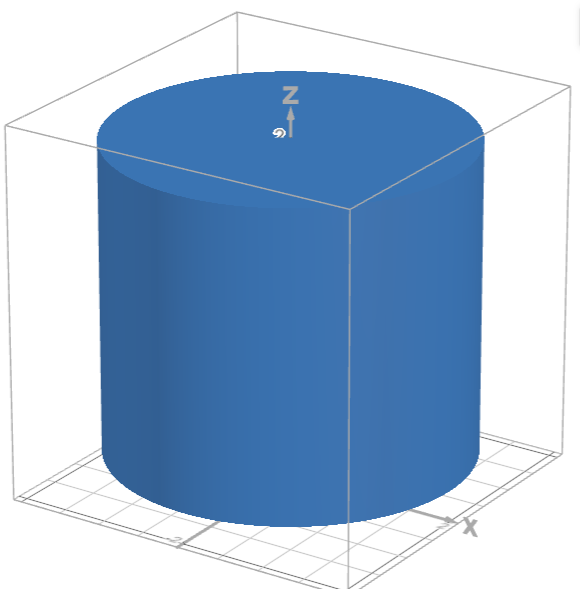
We can describe this region in cylindrical coordinates as
$$ \{ (r, \theta, z) | 0 \leq r \leq 2, 0 \leq \theta \leq 2\pi, 1 \leq z \leq 2 \}.$$
Plugging in the substitution \( dxdydz = rdr d\theta dz \), our new integral is
$$\int_1^2\int_0^{2\pi}\int_0^2 rz\ln{z} dr d\theta dz.$$
The inner integral is with respect to r, so we treat \( \theta \) and \( z \) as constants and integrate with respect to \( r \) to get
$$\frac{1}{2}\int_1^2\int_0^{2\pi} r^2z\ln{z}|_0^2 d\theta dz.$$
Applying the Fundamental Theorem of Calculus gives
$$2\int_1^2\int_0^{2\pi} z\ln{z} d\theta dz.$$
We now integrate with respect to \( \theta \) while treating z as a constant. This gives
$$2\int_1^2 \theta z\ln{z}|_0^{2\pi} dz.$$
Applying the Fundamental Theorem of Calculus again, we arrive at
$$4\pi\int_1^2 z\ln{z} dz.$$
To evaluate the remaining integral, we use integration by parts.
Choose \( u = \ln{z} \) and \( dv = zdz \), then \( du = \frac{1}{z}dz \) and \( v = \frac{1}{2}z^2 \). Applying the integration by parts formula, we obtain
$$4\pi(\frac{1}{2}z^2\ln{z}|_1^2 – \frac{1}{2}\int_1^2 z dz).$$
Now, we integrate with respect to z to obtain
$$4\pi(2\ln{2} – \frac{1}{4} z^2|_1^2).$$
Applying the Fundamental Theorem of Calculus once again, we arrive at a final answer of
$$4\pi(2\ln{2} – \frac{3}{4}).$$
Using Spherical Coordinates in Triple Integrals
Spherical coordinates are particularly well-suited for describing spherical regions.
Example 5: $$\iiint_E x^2 + y^2 + z^2 dV, \quad E: \text{solid ball of radius 1 centered at the origin}.$$
Solution: The following picture is a sketch of the region.
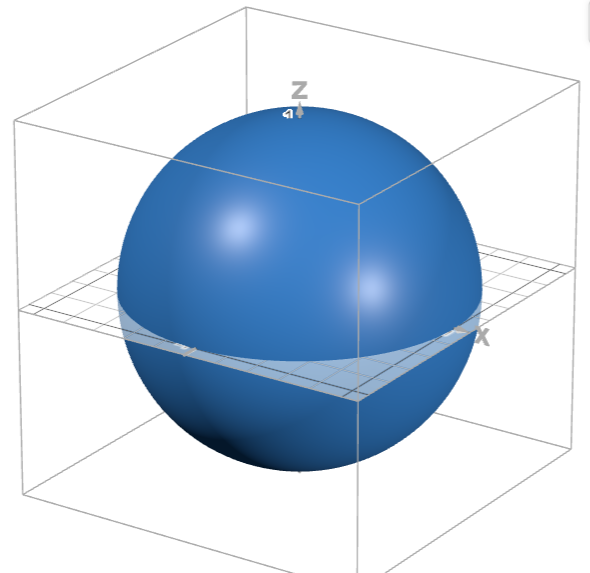
We can describe this region in spherical coordinates as
$$ \{ (\rho, \theta, \phi) | 0 \leq \rho \leq 1, 0 \leq \theta \leq 2\pi, 0 \leq \phi \leq \pi \}.$$
Plugging in the substitutions \( x^2 + y^2 + z^2 = \rho^2 \) and \( dxdydz = \rho^2\sin\phi d\rho d\theta d\phi \), our new integral is
$$\int_0^{\pi}\int_0^{2\pi}\int_0^1 \rho^4\sin\phi d\rho d\theta d\phi.$$
The inner integral is with respect to \( \rho \), so we treat \( \theta \) and \( \phi \) as constants and integrate with respect to \( \rho \) to get
$$\frac{1}{5}\int_0^{\pi}\int_0^{2\pi} \rho^5\sin\phi|_0^1 d\theta d\phi.$$
Applying the Fundamental Theorem of Calculus gives
$$\frac{1}{5}\int_0^{\pi}\int_0^{2\pi} \sin\phi d\theta d\phi.$$
We now integrate with respect to \( \theta \) while treating \( \phi \) as a constant. This gives
$$\frac{1}{5}\int_0^{\pi} \theta\sin\phi|_0^{2\pi} d\phi.$$
Applying the Fundamental Theorem of Calculus again, we arrive at
$$\frac{2\pi}{5}\int_0^{\pi} \sin\phi d\phi.$$
Now, we integrate with respect to \( \phi \) to obtain
$$-\frac{2\pi}{5}\cos\phi|_0^{\pi}.$$
Applying the Fundamental Theorem of Calculus once again, we arrive at a final answer of
$$\frac{4\pi}{5}.$$
Our last example uses techniques covered in the article How to Integrate Products of Trigonometric Functions: Techniques and Tricks
Example 6: Evaluate $$\iiint_E \sin^2\phi d\rho d\theta d\phi, \quad E: \text{upper hemisphere of radius 1}.$$
Solution: The following picture is a sketch of the region.
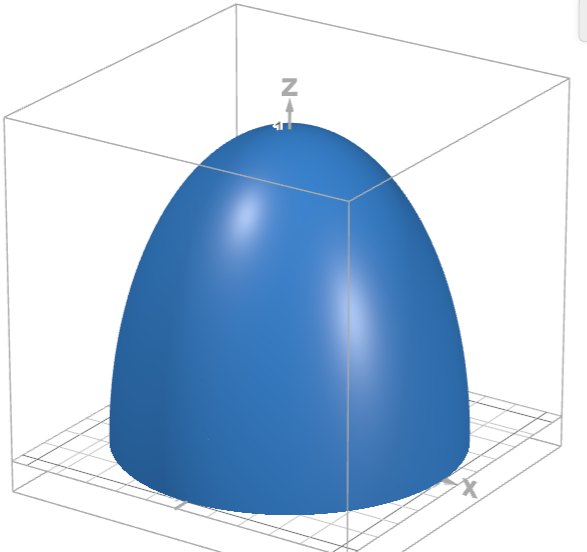
We can describe this region in spherical coordinates as
$$ \{ ( \rho, \theta, \phi ) | 0 \leq \rho \leq 1, 0 \leq \theta \leq 2\pi, 0 \leq \phi \leq \frac{\pi}{2} \}.$$
Setting up the bounds, our integral is
$$\int_0^{\frac{\pi}{2}}\int_0^{2\pi}\int_0^1 \sin^2\phi d\rho d\theta d\phi.$$
The inner integral is with respect to \( \rho \), so we treat \( \theta \) and \( \phi \) as constants and integrate with respect to \( \rho \) to get
$$\int_0^{\frac{\pi}{2}}\int_0^{2\pi} \rho\sin^2\phi|_0^1 d\theta d\phi$$
Applying the Fundamental Theorem of Calculus gives
$$\int_0^{\frac{\pi}{2}}\int_0^{2\pi} \sin^2\phi d\theta d\phi.$$
We now integrate with respect to \( \theta \) while treating \( \phi \) as a constant. This gives
$$\int_0^{\frac{\pi}{2}} \theta\sin^2\phi|_0^{2\pi} d\phi.$$
Applying the Fundamental Theorem of Calculus again, we arrive at
$$2\pi\int_0^{\frac{\pi}{2}} \sin^2\phi d\phi.$$
To evaluate the remaining integral, we apply the power-reducing identity for sine to obtain
$$\pi\int_0^{\frac{\pi}{2}} 1 – \cos2\phi d\phi.$$
Now, we integrate with respect to \( \phi \) to obtain
$$\pi\phi – \frac{\pi}{2}\sin2\phi|_0^{\frac{\pi}{2}}.$$
Applying the Fundamental Theorem of Calculus once again, we arrive at a final answer of
$$\frac{\pi^2}{2}.$$
Conclusion
Changing coordinates is one of the most powerful tools in multivariable calculus. Whether you’re working with double integrals over circular regions or triple integrals over cylinders and spheres, learning how to use polar, cylindrical, and spherical coordinates in integrals and choosing the right coordinate system can turn a seemingly difficult integral into something manageable.
Further Reading
How to Find the Determinant of a Matrix Step by Step: A Complete Beginner’s Guide – Calculating determinants is necessary to change variables of integration, another important technique for evaluating multiple integrals.

