

Examples of Improper Integrals with Solutions: A Beginner’s Guide
If you’re learning calculus, you’ve probably come across integrals with limits at infinity or negative infinity or that have a vertical asymptote in the interval of integration. These are called improper integrals. In this guide, we’ll walk through examples of improper integrals with solutions so you can see how to approach them step by step.
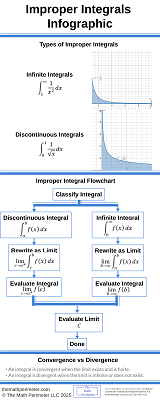
The following infographic illustrates the concepts covered in this article.
What Is an Improper Integral?
An improper integral is a definite integral where either the limits of integration are infinite, or the integrand has an infinite discontinuity somewhere in the interval of integration. We need to use limits to evaluate these integrals.
There are two main types of improper integrals:
Integrals with Infinite Limits of Integration
These occur when the interval of integration extends to positive or negative infinity. For example
$$\int_1^{\infty} \frac{1}{x^2} \, dx.$$
This isn’t a normal definite integral because you can’t plug \( \infty \) into the function. Instead, you rewrite it using a limit:
$$\int_1^{\infty} \frac{1}{x^2} \, dx = \lim_{b \to \infty} \int_1^b \frac{1}{x^2} \, dx.$$
We then evaluate the integral like usual and then take the limit.
Integrals with Discontinuous Integrands
Sometimes, the function you’re integrating is undefined at a certain point in the interval. For instance
$$\int_0^1 \frac{1}{\sqrt{x}} \, dx.$$
The function \( \frac{1}{\sqrt{x}} \) is undefined at \( x = 0 \), so we can’t evaluate this directly. Instead, we write
$$\int_0^1 \frac{1}{\sqrt{x}} \, dx = \lim_{a \to 0^+} \int_a^1 \frac{1}{\sqrt{x}} \, dx.$$
Again, the idea is to use a limit to handle the integral’s problematic part(s).
Steps to Evaluate Improper Integrals
Step 1: Split up the integral, if necessary
If the interval of integration has more than one point, that makes the integral improper, or if it’s an interior point, you must split the integral into multiple integrals. This can be done using one of the properties of definite integrals mentioned in the article Basic Integration Problems for Beginners.
Step 2: Rewrite as a limit
Rewrite the integral as a limit at the point which makes the integral improper.
Step 3: Evaluate the definite integral
Compute the definite integral. The Integral Calculus archive has resources to help you evaluate integrals using many techniques.
Step 4: Take the limit
Lastly, take the limit. For assistance, please refer to the article How to Calculate Limits in Calculus: Everything You Need to Know.
Improper Integrals with Infinite Limits of Integration
Improper integrals with infinite limits occur when the magnitude of either limit is infinite. Since infinity isn’t a number, you can’t plug it in directly. Instead, we rewrite these integrals using limits at infinity.
Example 1: Evaluate:
(a) \( \int_{-\infty}^0 e^x \, dx \)
(b) \( \int_1^\infty \frac{1}{x^2} \, dx \)
(c) \( \int_{-\infty}^{\infty} \frac{1}{1 + x^2} \, dx \)
Solution: (a) \( \int_{-\infty}^0 e^x \, dx \)
Rewriting as a limit gives
$$\lim_{a \to -\infty} \int_a^0 e^x dx.$$
Next, we evaluate the integral to get
$$\lim_{a \to -\infty} e^x|_a^0.$$
Applying the Fundamental Theorem of Calculus gives
$$\lim_{a \to -\infty} e^0 – e^a.$$
This is equivalent to
$$\lim_{a \to -\infty} 1 – e^a.$$
Taking the limit we obtain
$$1 – 0.$$
Subtracting, we arrive at a final answer of
$$1.$$
(b) \( \int_1^\infty \frac{1}{x^2} \, dx \)
Rewriting as a limit gives
$$\lim_{b \to \infty} \int_1^b \frac{1}{x^2} \, dx.$$
In terms of negative exponents, this is
$$\lim_{b \to \infty} \int_1^b x^{-2} \, dx.$$
Next, we evaluate the integral to get
$$\lim_{b \to \infty} -x^{-1}|_1^b.$$
This is equivalent to
$$\lim_{b \to \infty} -\frac{1}{x} |_1^b.$$
Applying the Fundamental Theorem of Calculus gives
$$\lim_{b \to \infty} -\frac{1}{b} + 1.$$
Taking the limit, we obtain
$$0 + 1.$$
Adding we arrive at a final answer of
$$1.$$
(c) \( \int_{-\infty}^{\infty} \frac{1}{1 + x^2} \, dx \)
We start by splitting the integral into two as follows:
$$\int_{-\infty}^0 \frac{1}{1 + x^2} \, dx + \int_0^{\infty} \frac{1}{1 + x^2} \, dx.$$
Rewriting the integrals as limits gives
$$\lim_{a \to -\infty} \int_a^0 \frac{1}{1 + x^2} \, dx + \lim_{b \to \infty} \int_0^b \frac{1}{1 + x^2} \, dx.$$
Next, we evaluate the integrals to get
$$\lim_{a \to -\infty} \arctan{x}|_a^0 + \lim_{b \to \infty} \arctan{x}|_0^b.$$
Applying the Fundamental Theorem of Calculus, we obtain
$$\lim_{a \to -\infty} \arctan{0} – \arctan{a} + \lim_{b \to \infty} \arctan{b} – \arctan{0}.$$
Evaluating the arctangents gives
$$- \lim_{a \to -\infty} \arctan{a} + \lim_{b \to \infty} \arctan{b}.$$
Taking the limits we obtain
$$-( -\frac{\pi}{2}) + \frac{\pi}{2}.$$
Multiplying we get
$$\frac{\pi}{2} + \frac{\pi}{2}.$$
Adding we arrive at a final answer of
$${\pi}.$$
Improper Integrals with Discontinuous Integrands
This type of improper integral arises when the function is undefined at one or more points within the interval of integration. In this case, we rewrite the integral using one-sided limits.
Example 2: Evaluate:
(a) \( \int_0^1 \frac{1}{\sqrt{x}} \, dx \)
(b) \( \int_{-1}^1 \frac{1}{x} \, dx \)
Solution: (a) \( \int_0^1 \frac{1}{\sqrt{x}} \, dx \)
The integrand is undefined at \( x = 0 \), so the integral is improper at the left endpoint. Rewriting as a limit gives
$$\lim_{a \to 0^+} \int_a^1 \frac{1}{\sqrt{x}} \, dx.$$
In terms of fractional exponents, this is
$$\lim_{a \to 0^+} \int_a^1 \frac{1}{x^{\frac{1}{2}}} \, dx.$$
This is equivalent to
$$\lim_{a \to 0^+} \int_a^1 x^{-\frac{1}{2}} \, dx.$$
Next, we evaluate the integral to get
$$\lim_{a \to 0^+} \left[ 2x^{\frac{1}{2}} \right]_a^1.$$
In terms of square roots, this is
$$\lim_{a \to 0^+} \left[ 2\sqrt{x} \right]_a^1.$$
By the Fundamental Theorem of Calculus, we have
$$\lim_{a \to 0^+} 2 – 2\sqrt{a}.$$
Taking the limit, we obtain
$$2 – 0.$$
Subtracting, we arrive at a final answer of
$$2.$$
(b) \( \int_{-1}^1 \frac{1}{x} \, dx \)
The integrand is undefined at \( x = 0 \), which lies inside the interval of integration. This means the integral is improper at an interior point. We split the integral into two as follows:
$$\int_{-1}^0 \frac{1}{x} \, dx + \int_0^1 \frac{1}{x} \, dx.$$
We evaluate each integral individually. Rewriting the first integral as a limit gives
$$\lim_{a \to 0^-} \int_{-1}^a \frac{1}{x} \, dx.$$
Integrating we obtain
$$\lim_{a \to 0^-} \left[ \ln|x| \right]_{-1}^a.$$
Applying the Fundamental Theorem of Calculus, we get
$$\lim_{a \to 0^-} (\ln|a| – \ln(1)).$$
Taking the limit we arrive at
$$-\infty.$$
There is no need to calculate the second integral. Since the first integral diverges, the entire integral diverges.
Conclusion
In this guide, we explored multiple examples of improper integrals with solutions, covering both types: those with unbounded intervals and those with discontinuities. Some integrals converged to a finite value, while others diverged.
Further Reading
The Ultimate Beginner’s Guide to Partial Derivatives with Step-by-Step Examples – Now that you are familiar with the tools of single variable calculus, you are now ready to learn multivariable calculus, starting with partial derivatives.

