
Euler Substitution Examples with Solutions: A Complete Step-by-Step Beginner’s Guide
Integrals containing expressions like \( \sqrt{a x^2 + b x + c} \) can be solved with standard techniques like substitution, completing the square, or trigonometric substitution, but are often not purely algebraic. That’s where Euler substitution comes in. This substitution transforms these integrals into integrals of rational functions. This guide explains the procedure and provides several Euler substitution examples with solutions.
Euler substitution replaces both \( x \) and \( \sqrt{a x^2 + b x + c} \) with rational expressions in a new variable \( t \), converting the integral into one involving only rational functions.
In this article, we’ll focus on understanding how and why Euler substitution works. You’ll learn when to use it, how to derive the substitution, and how to apply it.
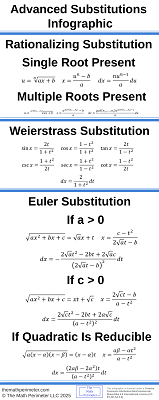
This article is part of a three-part series on advanced substitutions. The following infographic illustrates this topic.
When to Use Euler Substitution and Why It Works
In many integrals, you’ll encounter expressions that involve a square root of a quadratic, such as \( \sqrt{a x^2 + b x + c} \). You’ve already seen techniques that help deal with these expressions, such as substitution, completing the square, or trigonometric substitution, which were covered in the articles The Ultimate Step-by-Step Guide to Solving Integrals Using Substitution, The Ultimate Guide on How to Solve Integrals by Completing the Square, and Trigonometric Substitution for Beginners: A Step-by-Step Guide.
However, these approaches are not always the most direct path. That’s where Euler substitution becomes a powerful alternative. It allows you to rewrite integrands containing both \( x \) and \( \sqrt{a x^2 + b x + c} \) into rational functions of a new variable \( t \).
The goal is to remove the square root from the integral so the integrand becomes a rational function in \( t \). Once this transformation is made, you can use techniques like substitution, polynomial division, or partial fractions. These techniques are covered in How to Integrate Using Polynomial Long Division with Examples, A Comprehensive Beginner’s Guide to Partial Fraction Decomposition, and Partial Fraction Decomposition Integration Problems with Solutions: A Complete Tutorial.
The three Euler substitutions are:
$$\sqrt{a x^2 + b x + c} = \sqrt{a}\,x + t, a > 0$$
$$\sqrt{a x^2 + b x + c} = x t + \sqrt{c}, c > 0$$
$$\sqrt{a(x – \alpha)(x – \beta)} = (x – \alpha)t.$$
In all three cases, the same principle applies: substituting for \( \sqrt{a x^2 + b x + c} \) in this way ensures that both \( x \) and \( \sqrt{a x^2 + b x + c} \) become rational in \( t \). Euler substitution achieves the same outcome as completing the square and trigonometric substitution, removing the radical, but it does so algebraically. This makes it useful when you want a fully algebraic solution or when trigonometric substitution leads to a difficult integral.
General Procedure
Here’s the step-by-step process for applying Euler substitution.
Step 1: Check conditions
- If \( a > 0 \), use the first substitution.
- If \( c > 0 \), use the second substitution.
- If the quadratic has real roots, use the third substitution.
You may have more than one possible choice.
Step 2: Choose the appropriate substitution
$$\sqrt{a x^2 + b x + c} = \sqrt{a}\,x + t, a > 0$$
$$\sqrt{a x^2 + b x + c} = x t + \sqrt{c}, c > 0$$
$$\sqrt{a(x – \alpha)(x – \beta)} = (x – \alpha)t.$$
Step 3: Solve for x
Square both sides of the chosen substitution and solve for \( x \) as a rational function of \( t \). Each substitution is constructed so the \( x^2 \) terms cancel.
Step 4: Differentiate
Differentiate \( x \) to find the differential. For help, please refer to How to Differentiate a Function Step by Step: A Beginner’s Guide.
Step 5: Express the radical in terms of t.
Replace \( \sqrt{a x^2 + b x + c} \) with its expression in terms of \( t \) using the substitution and x as a function of t.
Step 6: Substitute and simplify
Replace \( x \), \( \sqrt{ax^2 + bx + c} \), and \( dx \) in the integral to obtain an integrand that is a rational function of the variable t. The guide Basic Integration Problems for Beginners can help with simplification.
Step 7: Integrate
Use integration techniques such as substitution, completing the square, polynomial division, or partial fraction decomposition.
Step 8: Back-substitute
After integrating, use the substitution equation to solve for \( t \) in terms of \( x \) and rewrite the final result in \( x \).
Worked Out Examples
Example 1: Evaluate:
(a) \( \int \frac{1}{\sqrt{x^2 + 4}}dx \)
(b) \( \int \frac{1}{\sqrt{x^2 + 9}} dx \)
(c) \( \int \frac{1}{\sqrt{x^2 – 9}} dx \)
Solution: (a) \( \int \frac{1}{\sqrt{x^2 + 4}}dx \)
Let \( \sqrt{x^2 + 4} = x + t \). Next, we solve for x. Start by squaring both sides to get
$$x^2 + 4 = x^2 + 2xt + t^2.$$
This implies
$$4 = 2xt + t^2.$$
Hence, we have
$$2xt = 4 – t^2.$$
This is equivalent to
$$x = \frac{4 – t^2}{2t}.$$
Next, we compute the differential to obtain
$$dx = -\frac{t^2 + 4}{2t^2} \, dt.$$
Substituting everything into the integral gives
$$-\int \frac{1}{\frac{4 – t^2}{2t} + t}\frac{t^2 + 4}{2t^2} dt.$$
Multiplying we obtain
$$\int \frac{t^2 + 4}{t(t^2 – 4) – 2t^3} dt.$$
Factoring out a t, we get
$$\int \frac{t^2 + 4}{t(t^2 – 4 – 2t^2)} dt.$$
This is equivalent to
$$-\int \frac{t^2 + 4}{t(t^2 + 4)} dt.$$
Simplifying we obtain
$$-\int \frac{1}{t} dt.$$
Integrating gives
$$-\ln{|t|} + C.$$
Back substituting, we arrive at a final answer of
$$-\ln{|\sqrt{x^2 + 4} – x|} + C.$$
(b) \( \int \frac{1}{\sqrt{x^2 + 9}} dx \)
Let \( \sqrt{x^2 + 9} = xt + 3 \). Next, we solve for x. Start by squaring both sides to get
$$x^2 + 9 = x^2 t^2 + 6xt + 9.$$
Subtracting 9 from both sides, we find
$$x^2 = x^2 t^2 + 6xt.$$
Dividing both sides by x, we obtain
$$x = x t^2 + 6t.$$
This implies that
$$x – x t^2 = 6t.$$
Factoring out an x from the left-hand side then gives
$$x(1 – t^2) = 6t.$$
Hence,
$$x = \frac{6t}{1 – t^2}.$$
Next, we compute the differential to obtain
$$dx = \frac{6(t^2 + 1)}{(1 – t^2)^2} dt.$$
Substituting everything into the integral gives
$$\int \frac{1}{\frac{6t^2}{1 – t^2} + 3} \frac{6(t^2 + 1)}{(1 – t^2)^2} dt.$$
Multiplying we obtain
$$\int \frac{6(t^2 + 1)}{6t^2(1 – t^2) + 3(1 – t^2)^2} dt.$$
Factoring out a \( 1 – t^2 \) we get
$$\int \frac{6(t^2 + 1)}{(6t^2 + 3(1 – t^2))(1 – t^2)} dt.$$
Distributing gives
$$\int \frac{6(t^2 + 1)}{(6t^2 + 3 – 3t^2)(1 – t^2)} dt.$$
This is equivalent to
$$\int \frac{6(t^2 + 1)}{(3t^2 + 3)(1 – t^2)} dt.$$
Factoring the denominator gives
$$\int \frac{6(t^2 + 1)}{3(t^2 + 1)(1 – t)(1 + t)} dt.$$
Simplifying we obtain
$$\int \frac{2}{(1 – t)(1 + t)} dt.$$
We now need to find the partial fraction decomposition of \( \frac{2}{(1 – t)(1 + t)} \). Setting up the partial fraction decomposition, we get
$$\frac{2}{(1 – t)(1 + t)} = \frac{A}{1 – t} + \frac{B}{1 + t}.$$
Next, multiplying both sides by \( (1 – t)(1 + t) \) gives
$$2 = A(1 + t) + B(1 – t).$$
Now, we determine the coefficients by choosing convenient values of x:
$$t = 1 \Rightarrow 2 = 2A \Rightarrow 1 = A.$$
$$t = -1 \Rightarrow 2 = 2B \Rightarrow 1 = B.$$
Thus,
$$\frac{2}{(1 – t)(1 + t)} = \frac{1}{1 – t} + \frac{1}{1 + t}.$$
Our integral is then
$$\int \frac{1}{1 – t} + \frac{1}{1 + t} dt.$$
Integrating gives
$$-\ln{|1 – t|} + \ln{|1 + t|} + C.$$
Using logarithmic properties, we arrive at
$$\ln{|\frac{1 + t}{1 – t}|} + C.$$
Back Substituting, we obtain
$$\ln{|\frac{1 + \frac{\sqrt{x^2 + 9} – 3}{x}}{1 – \frac{\sqrt{x^2 + 9} – 3}{x}}|} + C.$$
Simplifying, we arrive at a final answer of
$$\ln{|\frac{x – 3 + \sqrt{x^2 + 9}}{x – 3 – \sqrt{x^2 + 9}}|} + C.$$
(c) \( \int \frac{1}{\sqrt{x^2 – 9}} dx \)
Factoring, we get
$$\int \frac{1}{\sqrt{(x – 3)(x + 3}} dx.$$
Let \( \sqrt{(x – 3)(x + 3)} = (x – 3)t \). Next, we solve for x. Start by squaring both sides to get
$$(x – 3)(x + 3) = (x – 3)^2t^2.$$
Dividing both sides by x – 3, we obtain
$$x + 3 = (x – 3)t^2.$$
Distributing gives
$$x + 3 = xt^2 – 3t^2.$$
This implies that
$$3 + 3t^2 = xt^2 – x.$$
Factoring out an x from the right-hand side then gives
$$3 + 3t^2 = x(t^2 – 1).$$
Hence
$$\frac{3 + 3t^2}{t^2 – 1} = x.$$
Next, we compute the differential to obtain
$$-\frac{12t}{(t^2 – 1)^2}dt = dx.$$
Substituting everything into the integral gives
$$-\int \frac{1}{(\frac{3 + 3t^2}{t^2 – 1} – 3)t}\frac{12t}{(t^2 – 1)^2} dt.$$
Multiplying we obtain
$$-\int \frac{12}{(3 + 3t^2)(t^2 – 1) – 3(t^2 – 1)^2} dt.$$
Factoring out a \( 3(t^2 – 1) \) we get
$$-\int \frac{12}{3(t^2 – 1)(1 + t^2 – (t^2 – 1))} dt.$$
Subtracting then gives
$$-\int \frac{12}{3(t^2 – 1)(2)} dt.$$
This is equivalent to
$$-\int \frac{12}{6(t^2 – 1)} dt.$$
Simplifying gives
$$-\int \frac{2}{t^2 – 1} dt.$$
Factoring the denominator gives
$$-\int \frac{2}{(t – 1)(t + 1)} dt.$$
We now need to find the partial fraction decomposition of \( \frac{2}{(t – 1)(t + 1)} \). Setting up the partial fraction decomposition, we get
$$\frac{2}{(t – 1)(t + 1)} = \frac{A}{t – 1} + \frac{B}{t + 1}.$$
Next, multiplying both sides by \( (t – 1)(t + 1) \) gives
$$2 = A(t + 1) + B(t – 1).$$
Now, we determine the coefficients by choosing convenient values of x:
$$t = 1 \Rightarrow 2 = 2A \Rightarrow 1 = A.$$
$$t = -1 \Rightarrow 2 = -2B \Rightarrow -1 = B.$$
Thus,
$$\frac{2}{(t – 1)(t + 1)} = \frac{1}{t – 1} – \frac{1}{t + 1}.$$
Our integral is then
$$-\int \frac{1}{t – 1} – \frac{1}{t + 1} dt.$$
Integrating gives
$$-(\ln{|t – 1|} – \ln{|t + 1|}) + C.$$
Using logarithmic properties, we arrive at
$$-\ln{|\frac{t – 1}{t + 1}|} + C.$$
Back substituting gives
$$-\ln{|\frac{\frac{\sqrt{(x – 3)(x + 3)}}{x – 3} – 1}{\frac{\sqrt{(x – 3)(x + 3)}}{x – 3} + 1}|} + C.$$
This is equivalent to
$$-\ln{|\frac{\sqrt{(x – 3)(x + 3)} – x + 3}{\sqrt{(x – 3)(x + 3)} + x – 3}|} + C.$$
Simplifying, we arrive at a final answer of
$$-\ln{|\frac{\sqrt{x^2 – 9} – x + 3}{\sqrt{x^2 – 9} + x – 3}|} + C.$$
Conclusion
Euler substitution is a technique for evaluating integrals involving square roots of quadratic expressions. By transforming the integral into a rational function of a new variable \( t \), Euler substitution allows you to apply familiar integration techniques such as partial fractions, polynomial long division, completing the square, and substitution.
In this guide, we covered the three Euler substitutions, provided a step-by-step procedure for applying them, and provided Euler substitution examples with solutions for each substitution.
Further Reading
Examples of Rationalizing Substitution in Calculus: A Beginner-Friendly Guide – Rationalizing substitution is similar to Euler substitution, but applies to integrals containing roots of linear functions.
How to Use the Weierstrass Substitution Step by Step with Examples – Weierstrass substitution is similar to Euler substitution, but applies to integrals containing rational functions of trigonometric functions.

