
A Complete Beginner’s Guide to Polar, Cylindrical, and Spherical Coordinates in Calculus
In many calculus problems, using rectangular coordinates can make the math more complicated than it needs to be. This beginner’s guide to polar, cylindrical, and spherical coordinates will show you how switching to different coordinate systems can simplify these problems. Specifically, you’ll learn what polar, cylindrical, and spherical coordinates are, how to convert between these systems and rectangular coordinates, how to interpret and visualize points in each system, and how to differentiate functions written in these alternative coordinate systems.
This article focuses on building your understanding of coordinate systems. Whether you’re a student or just curious about the tools of multivariable calculus, this guide is the perfect place to start.
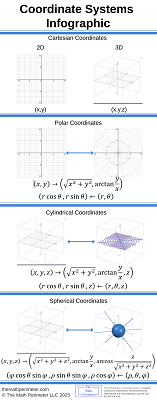
The following infographic illustrates the concepts covered in this article.
Rectangular Coordinates
Before discussing polar, cylindrical, and spherical coordinates, it’s important to review the system with which you’re already familiar: rectangular coordinates, also known as Cartesian coordinates.
In two dimensions, a point is represented as an ordered pair \( (x, y) \), where \( x \) is the horizontal distance from the origin, and \( y \) is the vertical distance from the origin. In three dimensions, a point is described by \( (x, y, z) \), where \( x \) and \( y \) work the same way as in 2D, and \( z \) represents the height above or below the \( xy \)-plane.
This system works well for problems involving straight lines, rectangles, planes, and boxes. However, it quickly becomes inefficient when dealing with circles, cylinders, or spheres. For example, describing a circle in Cartesian coordinates requires an equation like \( x^2 + y^2 = r^2 \), and describing a sphere takes the form \( x^2 + y^2 + z^2 = \rho^2 \).
These equations can be messy to work with, especially when performing calculus operations like differentiation or integration. That’s why we often switch to coordinate systems that are more naturally aligned with the problem’s geometry.
In the following sections, we’ll explore three alternative coordinate systems: polar coordinates, cylindrical coordinates, and spherical coordinates. Each coordinate system offers a new way to describe space and can simplify many of the problems you’ll encounter in multivariable calculus. Let’s start with polar coordinates.
Polar Coordinates
Polar coordinates represent a point in the plane using a radius \( r \) and an angle \( \theta \) where \( r \) is the distance from the origin to the point and \( \theta \) is the angle between the positive \( x \)-axis and the line from the origin to the point. Instead of \( (x, y) \), we now write \( (r, \theta) \). This system is ideal for problems with circular symmetry.
The formulas for converting between Cartesian and polar coordinates are:
$$r = \sqrt{x^2 + y^2}, \quad \theta = \arctan{(\frac{y}{x})}$$
$$x = r \cos\theta, \quad y = r \sin\theta.$$
Examples
Example 1: Convert the points and functions to the specified coordinates:
(a) \( (3, 4) \); Polar
(b) \( (2, \frac{\pi}{3}) \); Cartesian
(c) \( f(x, y) = x^2 + y^2 \); Polar
(d) \( f(r, \theta) = r \cos\theta \); Cartesian
Solution: (a) \( (3, 4) \); Polar
Using the formulas, we calculate
$$r = \sqrt{3^2 + 4^2} = \sqrt{25} = 5,$$
and
$$\theta = \arctan{(\frac{4}{3})} \approx 0.93.$$
Hence,
$$(r, \theta) = (5, 0.93).$$
(b) \( (2, \frac{\pi}{3}) \); Cartesian
Using the formulas, we calculate
$$x = 2 \cos\left(\frac{\pi}{3}\right) = 1,$$
and
$$y = 2 \sin\left(\frac{\pi}{3}\right) = \sqrt{3}.$$
Hence,
$$(x, y) = (1, \sqrt{3}).$$
(c) \( f(x, y) = x^2 + y^2 \); Polar
Using the formulas, we obtain
$$f(r, \theta) = r^2.$$
(d) \( f(r, \theta) = r \cos\theta \); Cartesian
Using the formulas, we obtain
$$f(x, y) = x.$$
Cylindrical Coordinates
Cylindrical coordinates extend polar coordinates to 3D. A point is described by \( (r, \theta, z) \) where \( r \) is the distance from the \( z \)-axis to the point, \( \theta \) is the angle in the \( xy \)-plane from the positive \( x \)-axis, and \( z \) is the same as in rectangular coordinates.
The formulas for converting between Cartesian and cylindrical coordinates are:
$$r = \sqrt{x^2 + y^2}, \quad \theta = \arctan{(\frac{y}{x})}, \quad z = z,$$
$$x = r \cos\theta, \quad y = r \sin\theta, \quad z = z.$$
Examples
Example 2: Convert the points and functions to the specified coordinates:
(a) \( (3, 4, 5) \); Cylindrical
(b) \( (2, \frac{\pi}{4}, 6) \); Cartesian
(c) \( f(x, y, z) = x^2 + y^2 + z^2 \); Cylindrical
(d) \( f(r, \theta, z) = r \sin\theta + z \); Cartesian
Solution: (a) \( (3, 4, 5) \); Cylindrical
Using the formulas, we calculate
$$r = \sqrt{3^2 + 4^2} = 5,$$
$$\theta = \arctan{(\frac{4}{3})} \approx 0.93,$$
and
$$z = 5.$$
Hence,
$$(r, \theta, z) = (5, 0.93, 5).$$
(b) \( (2, \frac{\pi}{4}, 6) \); Cartesian
Using the formulas, we calculate
$$x = 2\cos{\frac{\pi}{4}} = \sqrt{2},$$
$$y = 2\sin{\frac{\pi}{4}} = \sqrt{2},$$
and
$$z = 6.$$
Hence,
$$(x, y, z) = (\sqrt{2}, \sqrt{2}, 6).$$
(c) \( f(x, y, z) = x^2 + y^2 + z^2 \); Cylindrical
Using the formulas, we obtain
$$f(r, \theta, z) = r^2 + z^2.$$
(d) \( f(r, \theta, z) = r \sin\theta + z \); Cartesian
Using the formulas, we obtain
$$f(x, y, z) = y + z.$$
Spherical Coordinates
Spherical coordinates describe a point with a radius and two angles. \( (\rho, \theta, \phi) \), where \( \rho \) is the distance from the origin, \( \theta \) is the angle in the \( xy \)-plane from the positive \( x \)-axis, and \( \phi \) is the angle from the positive \( z \)-axis downward.
The formulas for converting between Cartesian and spherical coordinates are:
$$\rho = \sqrt{x^2 + y^2 + z^2}, \quad \theta = \arctan{(\frac{y}{x})}, \quad \phi = \arccos{(\frac{z}{\rho})},$$
$$x = \rho \sin\phi \cos\theta, \quad y = \rho \sin\phi \sin\theta, \quad z = \rho \cos\phi.$$
Examples
Example 3: Convert the points and functions to the specified coordinates:
(a) \( (1, 1, \sqrt{2}) \); Spherical
(b) \( (3, \frac{\pi}{2}, \frac{\pi}{3}) \); Cartesian
(c) \( f(x, y, z) = x^2 + y^2 + z^2 \); Spherical
(d) \( f(\rho, \theta, \phi) = \rho \cos\phi \); Cartesian
Solution: (a) \( (1, 1, \sqrt{2}) \); Spherical
Using the formulas, we calculate
$$\rho = \sqrt{1^2 + 1^2 + \sqrt{2}^2} = \sqrt{4} = 2,$$
$$\theta = \arctan{\frac{1}{1}} = \frac{\pi}{4},$$
and
$$\phi = \arccos{\frac{\sqrt{2}}{2}} = \frac{\pi}{4}.$$
Hence,
$$(\rho, \theta, \phi) = (2, \frac{\pi}{4}, \frac{\pi}{4}).$$
(b) \( (3, \frac{\pi}{2}, \frac{\pi}{3}) \); Cartesian
Using the formulas, we calculate
$$x = 3\sin{\frac{\pi}{3}}\cos{\frac{\pi}{2}} = 0,$$
$$y = 3\sin{\frac{\pi}{3}}\sin{\frac{\pi}{2}} = \frac{3\sqrt{3}}{2},$$
and
$$z = 3\cos{\frac{\pi}{3}} = \frac{3}{2}.$$
Hence,
$$(x, y, z) = (0, \frac{3\sqrt{3}}{2}, \frac{3}{2}).$$
(c) \( f(x, y, z) = x^2 + y^2 + z^2 \); Spherical
Using the formulas, we obtain
$$f(\rho, \theta, \phi) = \rho^2.$$
(d) \( f(\rho, \theta, \phi) = \rho \cos\phi \); Cartesian
Using the formulas, we obtain
$$f(x, y, z) = z.$$
Differentiation in Polar, Cylindrical, and Spherical Coordinates
In the articles, How to Differentiate a Function Step by Step: A Beginner’s Guide and The Ultimate Beginner’s Guide to Partial Derivatives with Step-by-Step Examples, we learned how to differentiate functions in Cartesian coordinates. Fortunately, the procedure is similar for polar, cylindrical, and spherical coordinates.
Understanding how to take partial derivatives in different coordinate systems is an important skill in calculus. Whether you’re working with circular symmetry in 2D or spherical symmetry in 3D, switching coordinate systems can make differentiation simpler.
In this section, you’ll learn how to compute partial derivatives with respect to the variables in polar, cylindrical, and spherical coordinates.
Differentiation in Polar Coordinates
In polar coordinates, a function \( f(r, \theta) \) depends on the radial distance \( r \) and the angle \( \theta \) and can be differentiated with respect to either variable.
Example 4: Find all partial derivatives of \( f(r,\theta) = r^2 \cos \theta \).
Solution: To find \( \frac{\partial f}{\partial r} \), we treat \( \theta \) as a constant and differentiate with respect to r using the power rule to obtain
$$f_r = 2r\cos{\theta}.$$
Similarly, to find \( \frac{\partial f}{\partial \theta} \) we treat \( r \) as a constant and differentiate with respect to \( \theta \) to get
$$f_{\theta} = -r^2\sin{\theta}.$$
Differentiation in Cylindrical Coordinates
In cylindrical coordinates, a function \( f(r, \theta, z) \) depends on the radius \( r \), angle \( \theta \), and height \( z \), and can be differentiated with respect to any of the three variables.
Example 5: Find all partial derivatives of \( f(r, \theta, z) = r \cos \theta + z^2 \).
Solution: To find \( \frac{\partial f}{\partial r} \), we treat the variables \( \theta \) and \( z \) as constants and differentiate with respect to \( r \) to obtain
$$f_r = \cos \theta.$$
Similarly, to find \( \frac{\partial f}{\partial \theta} \), we treat \( r \) and \( z \) as constants and differentiate with respect to \( \theta \) to get
$$f_{\theta} = -r\sin\theta.$$
Lastly, to find \( \frac{\partial f}{\partial z} \) we treat \( r \) and \( \theta \) as constants and differentiate with respect to \( z \) using the power rule, which gives
$$f_z = 2z.$$
Differentiation in Spherical Coordinates
In spherical coordinates, a function \( f(\rho, \theta, \phi) \) depends on the radius \( \rho \), the angle \( \theta \), and the angle \( \phi \), and can be differentiated with respect to any of the three variables.
Example 6: Find all partial derivatives of \( f(\rho, \theta, \phi) = \rho \sin \phi \cos \theta \).
Solution: To find \( \frac{\partial f}{\partial \rho} \) we treat the variables \( \theta \) and \( \phi \) as constants and differentiate with respect to \( \rho \) to obtain
$$f_{\rho} = \sin \phi \cos \theta.$$
Similarly, to find \( \frac{\partial f}{\partial \theta} \) we treat \( \rho \) and \( \phi \) as constants and differentiate with respect to \( \theta \) to get
$$f_{\theta} = -\rho \sin \phi \sin \theta.$$
Lastly, to find \( \frac{\partial f}{\partial \phi} \) we treat \( \rho \) and \( \theta \) as constants and differentiate with respect to \( \phi \) which gives
$$f_{\phi} = \rho \cos \phi \cos \theta.$$
Conclusion
Polar, cylindrical, and spherical coordinates provide tools for solving problems in calculus. While Cartesian coordinates are often the default in early calculus courses, switching to a coordinate system that matches the geometry of a problem can help simplify the work. In this beginner’s guide to polar, cylindrical, and spherical coordinates, you’ve learned how to convert between Cartesian and each of the three coordinate systems, how to express functions in alternate coordinate systems and return them to Cartesian form, and how to compute partial derivatives with respect to each coordinate variable. These skills lay the foundation for more advanced applications, including evaluating multiple integrals in different coordinate systems.
Further Reading
Step-by-Step Tutorial on How to Use Polar, Cylindrical, and Spherical Coordinates in Integrals – Now that you understand coordinate systems, you are ready to learn how to evaluate multiple integrals by changing coordinates.

