
How to Find the Area Between Two Curves Using Definite Integrals
Definite integrals are an important calculus tool for calculating areas bounded by curves. One common application is determining the area enclosed between two functions, which requires understanding how the graphs intersect and how their relative positions affect the integration process. Learning how to find the area between two curves involves identifying the region’s boundaries, setting up an appropriate definite integral, and evaluating it to find the enclosed area.
In this guide, we will explore how definite integrals can be used to find the area between two curves. We will begin by examining signed area under a curve, introduce the formulas for calculating the area between functions, and outline a step-by-step procedure for solving these problems. Finally, we will work through several examples involving different types of curves and integration methods.
Since finding area between curves is an application of integrals, you may wish to review the article Basic Integration Problems for Beginners before proceeding.
Signed Area Under a Curve
Before learning how to calculate the area between two curves, it is important to understand how definite integrals represent the area between a function and the x-axis. In particular, we need to distinguish between signed area and area.
A definite integral measures the signed area between a function and the x-axis over a specified interval. Regions above the x-axis contribute positive values, while regions below the x-axis contribute negative values. As a result, the value of a definite integral does not always represent the total area enclosed by a curve and the x-axis.
In the article Riemann Sum Approximation Examples for Beginners, we approximated signed areas using Riemann sums and showed that taking the limit as n approaches infinity yields the definite integral.
Area Above the x-Axis
Consider a continuous function \( f(x) \) that lies entirely above the x-axis on the interval \( [a,b] \). The definite integral of the function over this interval represents the area between the curve and the x-axis.
The area is calculated using the following formula
$$A = \int_a^b f(x)dx.$$
Where \( f(x) \) represents the function being integrated, \( a \) represents the lower limit of integration, and \( b \) represents the upper limit of integration.
Because the function is positive throughout the interval, the definite integral is positive. In this case, the signed area equals the area.
Area Below the x-Axis
Now consider a continuous function \( f(x) \) that lies entirely below the x-axis on the interval \( [a,b] \).
Since the function takes negative values throughout the interval, its definite integral is negative.
However, area cannot be negative. Therefore, when calculating the area between
a curve and the x-axis, we take the absolute value of the definite integral.
This distinction is important when working with functions that cross the x-axis. If a function has both positive and negative regions over an interval, we must divide the interval at its x-intercepts and calculate the area of each region separately.
Example
Example 1: Find the signed area between the graph of the function \( f(x) = x^2 – 4 \) and the x-axis over the interval \( [0,2] \).
Solution: The definite integral we need to calculate is
$$\int_0^2 x^2 – 4dx.$$
Using the sum rule, this is
$$\int_0^2 x^2dx – \int_0^2 4dx.$$
Integrating gives
$$\frac{x^3}{3}|_0^2 – 4x|_0^2.$$
By the Fundamental Theorem of Calculus, this is
$$\frac{2^3}{3} – \frac{0^3}{3} – (4(2) – 4(0)).$$
Cubing we get
$$\frac{8}{3} – \frac{0}{3} – (4(2) – 4(0)).$$
Dividing and multiplying, we obtain
$$\frac{8}{3} – 0 – (8 – 0).$$
Subtracting gives
$$\frac{8}{3} – 8.$$
Obtaining a common denominator, we get
$$\frac{8}{3} – \frac{24}{3}.$$
Subtracting, we arrive at a final answer of
$$-\frac{16}{3}.$$
Finding the Area Between Two Curves
Finding the area between two curves involves calculating the region enclosed by their graphs over a specified interval. Unlike finding the area between a single curve and the x-axis, this process requires considering the difference between two functions.
Definite integrals allow us to calculate this area by dividing the region into narrow rectangular strips and summing their contributions. The height of each strip equals the difference between the two functions. Depending on the orientation of the region, we can integrate with respect to either \( x \) or \( y \).
Understanding the Area Between Two Curves
Consider two continuous functions, \( f(x) \) and \( g(x) \), that intersect at two points, \( x = a \) and \( x = b \). These functions enclose a region over the interval \( [a,b] \).
If \( f(x) \) lies above \( g(x) \) throughout the interval, the height of a vertical rectangular strip is given by
$$\text{Height} = f(x) – g(x).$$
The width of each strip is represented by \( dx \). Therefore, the area of a rectangular strip is
$$dA = [f(x) – g(x)]dx.$$
To find the area between the curves, we integrate the difference between the functions over the interval:
$$A = \int_a^b [f(x) – g(x)]dx.$$
This means that we subtract the lower function from the upper function and integrate the result over the specified interval.
It is important to identify which function lies above the other before setting up the integral. If the functions intersect within the interval and switch positions, the integral must be divided into separate intervals to ensure that the area is positive.
Formula for the Area Between Two Curves
When integrating with respect to \( x \), the general formula for the area between two curves is
$$A = \int_a^b [f(x) – g(x)]dx.$$
Where \( f(x) \) represents the upper function, \( g(x) \) represents the lower function, \( a \) represents the left intersection point or lower limit of integration, and \( b \) represents the right intersection point or upper limit of integration.
To determine the integration limits, we find the intersection points by setting the functions equal to each other
$$f(x) = g(x).$$
Solving this equation gives the \( x \)-coordinates of the intersection points, which can be used as the limits of integration when they bound the region.
Area Between Two Curves Using Horizontal Slices
In some situations, integrating with respect to \( x \) is not the most convenient approach. Instead, we can calculate the area between two curves using horizontal rectangular strips and integrate with respect to \( y \).
With horizontal slices, the width of each rectangular strip is the difference between the rightmost and leftmost functions.
Therefore, the area between two curves is calculated using
$$A = \int_c^d [R(y) – L(y)]dy$$
Where \( R(y) \) represents the rightmost function, \( L(y) \) represents the leftmost function, \( c \) represents the lower limit of integration, and \( d \) represents the upper limit of integration.
The integration limits are determined by the \( y \)-coordinates of the intersection points or the horizontal boundaries of the enclosed region.
Integrating with respect to \( y \) is particularly useful when the curves are easier to express as functions of \( y \), or when horizontal slices let us describe the region with a single integral instead of multiple integrals.
Step-by-Step Procedure
Finding the area between two curves using definite integrals involves identifying the functions that bound the region, determining their intersection points, and setting up an appropriate integral. Following a systematic procedure makes these problems easier to solve and helps minimize common errors.
The following steps provide a general approach for finding the area between two curves.
Step 1: Identify the Two Functions
Begin by identifying the two functions that define the boundaries of the region. These functions may be expressed in terms of \( x \) or \( y \).
Step 2: Find the Points of Intersection
The intersection points determine where the two curves meet and often provide the limits of integration.
To find these points, set the two functions equal to each other:
Solve the resulting equation for \( x \) or \( y \). If the functions intersect at multiple points, identify all relevant solutions that bound the region.
Step 3: Sketch the Graphs
Sketching the two functions helps visualize the region whose area we want to calculate.
A graph can help determine the appropriate integration limits and prevent errors when setting up the integral.
Step 4: Set Up the Definite Integral
Once the functions and limits of integration have been determined, set up the definite integral.
For vertical slices, use
$$A = \int_a^b [f(x) – g(x)]dx$$
where \( f(x) \) is the upper function and \( g(x) \) is the lower function.
For horizontal slices, use
$$A = \int_c^d [R(y) – L(y)]dy$$
where \( R(y) \) is the rightmost function and \( L(y) \) is the leftmost function.
If the functions intersect within the integration interval and switch positions, divide the region into separate intervals. Calculate the area of each interval independently, then add the results to get the total area.
Step 5: Evaluate the Definite Integral
After setting up the integral, find the antiderivative of the integrand and evaluate it at the integration limits.
Worked Out Examples
The first example shows how to find the area between two curves using vertical slices.
Example 2: Find the area enclosed between the curves \( f(x) = x^2 \) and \( g(x) = 2x \).
Solution: To find the points of intersection, we solve
$$x^2 = 2x.$$
Subtracting \( 2x \) from both sides, we get
$$x^2 – 2x = 0.$$
Factoring gives
$$x(x – 2) = 0.$$
This implies
$$x = 0, x – 2 = 0.$$
Adding 2 to both sides of the second equation, we find
$$x = 0, x = 2.$$
Below is a sketch of the region
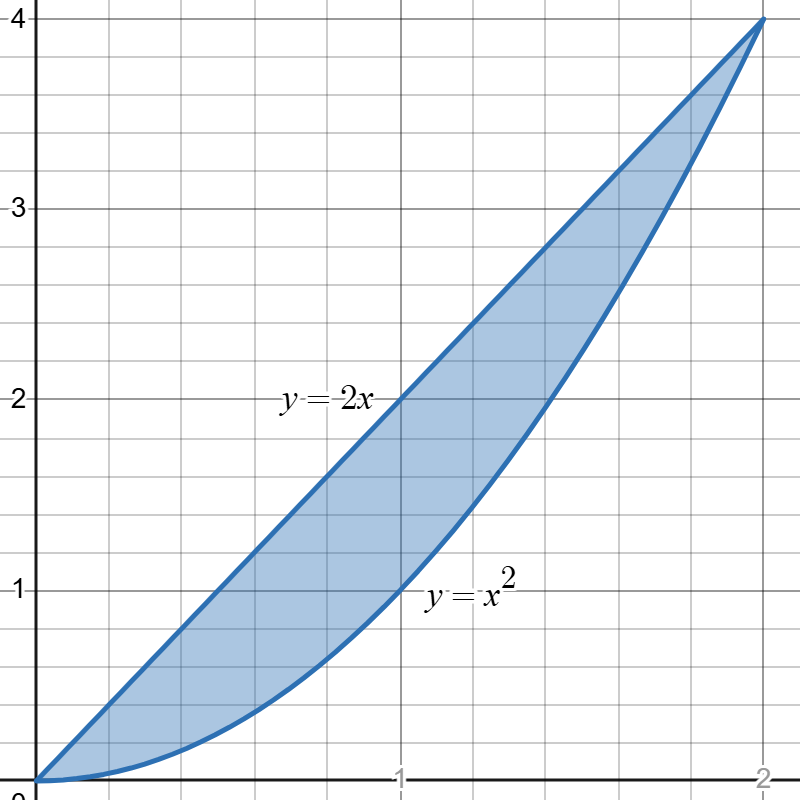
The definite integral we need to calculate is then
$$\int_0^2 2x – x^2dx.$$
Using the sum rule, this is
$$\int_0^2 2xdx – \int_0^2 x^2dx.$$
Integrating gives
$$x^2|_0^2 – \frac{x^3}{3}|_0^2.$$
By the Fundamental Theorem of Calculus, this is
$$2^2 – 0^2 – (\frac{2^3}{3} – \frac{0^3}{3}).$$
Exponentiating we get
$$4 – 0 – (\frac{8}{3} – \frac{0}{3}).$$
Dividing we obtain
$$4 – 0 – (\frac{8}{3} – 0).$$
Subtracting gives
$$4 – \frac{8}{3}.$$
Obtaining a common denominator, we get
$$\frac{12}{3} – \frac{8}{3}.$$
Subtracting, we arrive at a final answer of
$$\frac{4}{3}.$$
The next example shows how to find the area between two curves using horizontal slices.
Example 3: Find the area enclosed between the curves \( x = y^2 \) and \( x = 2 – y \).
Solution: To find the points of intersection, we solve
$$y^2 = 2 – y.$$
Adding \( y – 2 \) to both sides, we get
$$y^2 + y – 2 = 0.$$
Factoring gives
$$(y – 1)(y + 2) = 0.$$
This implies
$$y – 1 = 0, y + 2 = 0.$$
Adding 1 to both sides of the first equation and subtracting 2 from both sides of the second equation, we find
$$y = 1, y = -2.$$
Below is a sketch of the region
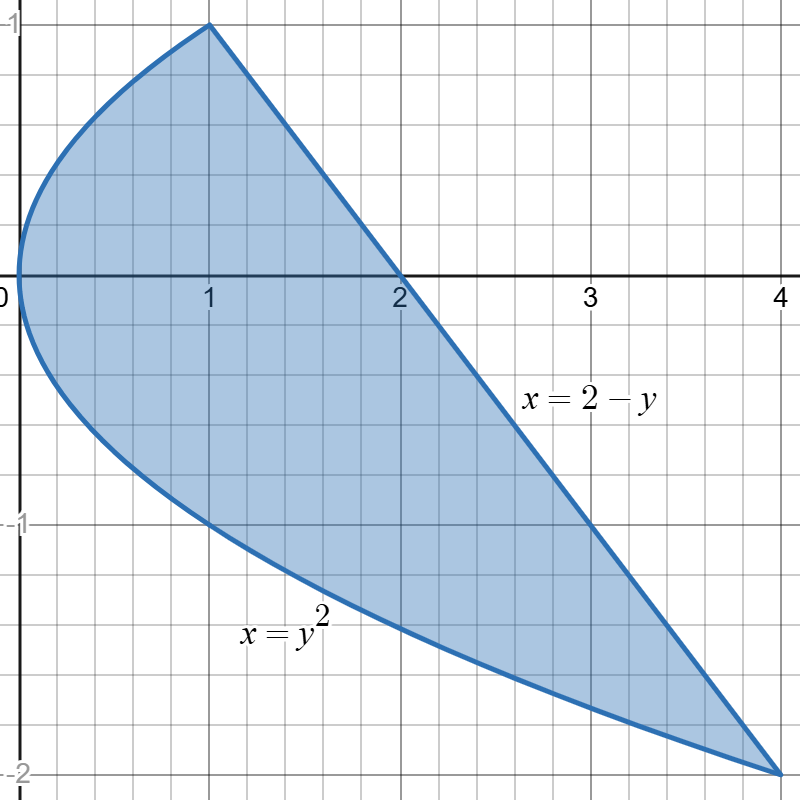
The definite integral we need to calculate is then
$$\int_{-2}^1 2 – y – y^2dy.$$
Using the sum rule, this is
$$\int_{-2}^1 2dy – \int_{-2}^1 ydy – \int_{-2}^1 y^2dy.$$
Integrating gives
$$2y|_{-2}^1 – \frac{y^2}{2}|_{-2}^1 – \frac{y^3}{3}|_{-2}^1.$$
By the Fundamental Theorem of Calculus, this is
$$2(1) – 2(-2) – (\frac{1^2}{2} – \frac{(-2)^2}{2}) – (\frac{1^3}{3} – \frac{(-2)^3}{3}).$$
Exponentiating we get
$$2 + 4 – (\frac{1}{2} – \frac{4}{2}) – (\frac{1}{3} – \frac{-8}{3}).$$
Adding and subtracting gives
$$6 – \frac{-3}{2} – \frac{9}{3}.$$
Obtaining common denominators, we get
$$\frac{12}{2} – \frac{-3}{2} – \frac{6}{2}.$$
Subtracting, we arrive at a final answer of
$$\frac{9}{2}.$$
Conclusion
Finding the area between two curves is an important application of definite integrals. By understanding the relationship between the functions that bound a region, we can use integration to calculate the area enclosed between their graphs. Learning how to find the Area Between Two Curves involves identifying intersection points, determining the relative positions of the functions, and evaluating a definite integral.
An important concept in this process is the distinction between signed area and area. While definite integrals can produce negative values when a function lies below the x-axis, area must always be non-negative. Similarly, when two curves intersect and switch positions, you may need to split the integration interval into separate regions to calculate the area correctly.
Further Reading
The Ultimate Step by Step Guide to Solving Integrals Using Substitution – Learn how to simplify integrals by using substitution to transform complicated expressions into more manageable forms.
Integration by Parts Explained with Examples: A Step-by-Step Guide – Explore another integration technique based on the product rule of differentiation and learn how to evaluate integrals involving products of functions.
Frequently Asked Questions
Support The Math Perimeter
If you enjoyed this article, please consider supporting The Math Perimeter on Buy Me a Coffee, so I can keep making more content like it.

